
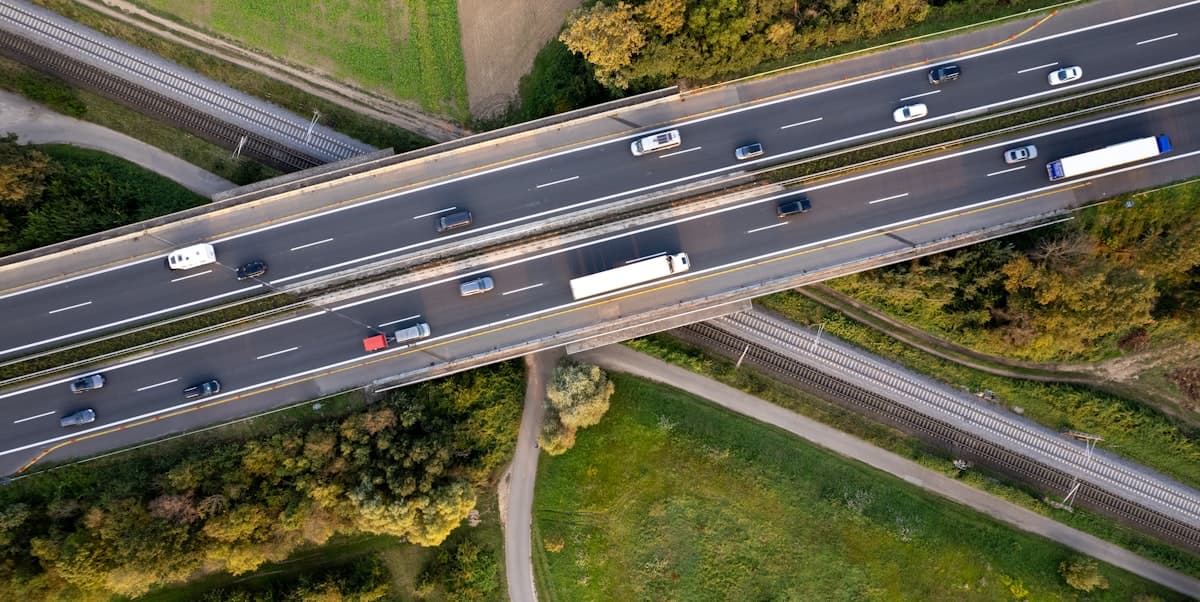
When Baldwin County opened the Baldwin Beach Express in August 2014, it solved an immediate problem: crushing traffic on State Route 59 during beach season. What few people anticipated was that this 13-mile highway would become the spine of one of the most significant economic development corridors on the Gulf Coast. Now, with the Baldwin Beach Express II extension advancing toward Interstate 65, the corridor is positioned to reshape real estate values, attract billions in industrial investment, and fundamentally change the growth trajectory of Baldwin County for the next decade and beyond.
The Original Route and What It Changed
The Baldwin Beach Express — originally designated Baldwin County Route 83 — runs 13.2 miles from its southern terminus near Foley, where it connects to the Foley Beach Express, north to County Route 68 east of Loxley. The four-lane divided highway intersects U.S. Route 90 east of Robertsdale and connects to Interstate 10 at Exit 49. It was purpose-built to relieve congestion on SR 59, which had become a bottleneck during peak tourist season, turning a 30-minute drive into a multi-hour ordeal.
The impact was immediate. The Beach Express gave residents and visitors a reliable, high-speed alternative route between the beaches and the interstate system. But the real story played out along the corridor itself. Land that had been rural farmland suddenly had frontage on a modern four-lane highway with interstate access. Commercial development followed, and property values along the route began a steady climb that continues today.
In April 2024, the transformation accelerated when Governor Ivey announced that the state would acquire the Beach Express Bridge for $57 million, eliminating tolls immediately. The Memorial Day weekend that followed saw traffic volumes on the bridge jump 25 percent compared to the prior year. Removing the toll barrier made the corridor accessible to a broader base of daily commuters, not just beach-bound tourists, and that shift in usage patterns has significant implications for commercial and residential development along the route.
Baldwin Beach Express II: The Extension to I-65
The original Beach Express connected the beaches to I-10. Baldwin Beach Express II will complete the corridor by extending it 25 miles from I-10 all the way to Interstate 65. When finished, a driver will be able to travel from Orange Beach to I-65 on a continuous, modern, multi-lane divided highway — a direct link between the Gulf Coast and the national interstate system that will fundamentally change regional connectivity.
The project has been advancing through a series of critical milestones. In February 2025, the Baldwin County Commission allocated $4 million from Capital Project Funds for right-of-way acquisition along a two-mile stretch between I-10 and the Styx River, and approved Volkert, Inc. to perform acquisition services.
In January 2026, the Commission adopted an updated Access Management Plan for the BBE II corridor, establishing the framework for how the highway will interact with surrounding roads and development. Then in February 2026, the Commission approved an engineering services agreement with Volkert, Inc. for design upgrades along the northernmost 4.9-mile section from U.S. Highway 31 to Interstate 65.
The design upgrades are substantial. The updated plans include redesigned interchanges at U.S. 31 and I-65, a new diamond-style interchange at the Novelis facility, expansion to six lanes between the Novelis interchange and I-65, updated bridge designs, and environmental permitting and coordination to meet current Alabama Department of Transportation and AASHTO standards. The design phase is expected to take approximately 12 months, with right-of-way acquisition to follow and construction anticipated to begin within roughly 24 months.
Three major interchanges — at U.S. 31, I-65, and the Novelis site — will create new nodes of accessibility that historically drive concentrated development in their immediate vicinities.
The Novelis Connection
The new diamond-style interchange at the Novelis facility is not a coincidence. Novelis is building the first fully integrated aluminum recycling and rolling plant constructed in the United States in 40 years, located at the 3,000-acre South Alabama Mega Site in Bay Minette. Originally announced as a $2.5 billion investment, the project has grown to $4.1 billion — making it the single largest private investment in Alabama history.
The plant will create approximately 1,000 direct jobs and is expected to begin operations in late 2026. It will serve the beverage packaging and automotive markets, powered by renewable energy, using recycled water, and operating as a zero-waste facility. Novelis has also announced plans for an Advanced Manufacturing and Leadership Training Center in Daphne at the Innovation and Science Complex, positioning Baldwin County as a hub for metals industry workforce development.
A dedicated interchange connecting the Beach Express II corridor directly to a $4.1 billion manufacturing facility tells you everything you need to know about the scale of infrastructure investment the county is making. That interchange will not only serve the plant's workforce and logistics needs but will also catalyze commercial and residential development in the surrounding area as supporting businesses, housing, and services cluster around the facility.
Commercial and Industrial Development Along the Corridor
The Novelis plant is the headline, but it is far from the only industrial story along this corridor. Port Alabama Industrial Center in Loxley, situated just south of I-10 along Highways 59 and 90, broke ground in August 2024 on a 904-acre development that will ultimately deliver approximately 12 million square feet of Class A industrial space. The first phase alone encompasses 2 million square feet and is expected to generate up to 1,000 jobs. The site's proximity to I-10, the Port of Mobile, and Mobile International Airport — all within 20 minutes — makes it a prime location for industrial, light manufacturing, data center, and distribution users.
Together, these developments represent a structural shift in Baldwin County's economy. For decades, the county's growth story was driven primarily by tourism and residential migration. The Beach Express corridor is now adding an industrial and logistics dimension that diversifies the economic base and creates year-round, high-wage employment. That diversification makes the local real estate market more resilient and less dependent on seasonal tourism cycles.
Commercial development along the existing Beach Express has already responded to growing traffic volumes. Retail, dining, and service businesses have established positions along the corridor, and the pattern will intensify as BBE II brings additional daily traffic from communities between I-10 and I-65.
Impact on Residential Development and Property Values
The relationship between highway corridors and residential real estate values is well documented. The Monroe Expressway in North Carolina offers a useful parallel: after it opened, communities like Monroe and Wingate that had been known for affordability saw median home prices climb steadily, with new developments now starting in the $400,000s and higher. The pattern repeats across markets — improved access drives demand, demand drives development, and development drives appreciation.
Baldwin County is already one of the fastest-growing counties in Alabama, with its population reaching approximately 267,761 by mid-2025, a 2.3 percent annual growth rate that is nearly four times the state average. Over the decade from 2014 to 2024, the county's population grew 30.7 percent, tying it with Limestone County for the fastest growth rate in the state. At the current pace, Baldwin County is projected to reach 300,000 residents by the 2030 census.
That growth is not evenly distributed, and the Beach Express corridor is emerging as one of the primary axes along which it concentrates. Communities with direct access to the expressway — Loxley, Robertsdale, and the areas between Foley and I-10 — are seeing accelerated residential development as buyers seek proximity to both the beaches and the employment centers emerging along the corridor. The combination of highway access, job growth from Novelis and Port Alabama, and relatively affordable land prices compared to beachfront markets creates a compelling value proposition for homebuyers and developers alike.
Properties within a few miles of planned interchange locations deserve particular attention. Historical data from comparable expressway projects consistently shows that land values within a one-to-three-mile radius of new interchanges appreciate at rates significantly above the surrounding market in the years following construction.
Investment Opportunities: What to Watch
For real estate investors evaluating the Beach Express corridor, several specific opportunities stand out:
Land near planned interchanges. The new interchanges at U.S. 31, I-65, and the Novelis site will create pockets of intense demand for commercial and residential development. Parcels with visibility and access to these interchanges will command premium values once construction begins.
Workforce housing near Novelis. One thousand direct jobs at the Novelis plant, plus the multiplier effect of supporting businesses, will generate significant housing demand in the Bay Minette and north Baldwin County area. Rental properties and affordable single-family homes in this submarket are positioned for strong performance.
Commercial parcels along the existing Beach Express. Rising traffic volumes — boosted by toll removal and the eventual connection to I-65 — support retail, dining, and service-oriented commercial development along the corridor. Properties with highway frontage and good ingress and egress are increasingly valuable.
Loxley and the I-10 corridor. The Port Alabama Industrial Center will bring thousands of jobs to the Loxley area over the coming years. Residential development in Loxley, Robertsdale, and surrounding communities stands to benefit directly from this employment growth.
Looking Ahead
The Baldwin Beach Express corridor represents something rare in real estate: a clearly defined infrastructure investment with a visible timeline, measurable economic catalysts, and a growth trajectory supported by demographic data. The original expressway transformed beach access and spurred development along its route. The BBE II extension will connect that corridor to the interstate system and to billions of dollars in industrial investment.
Baldwin County is building the infrastructure to support a population of 300,000 and an economy that extends well beyond tourism. The Beach Express corridor is central to that vision, and the real estate market along it will reflect that transformation in the years ahead.
For investors and buyers looking at Baldwin County, the fundamentals are straightforward: follow the infrastructure, watch the interchange locations, and understand that the corridor connecting Orange Beach to I-65 is becoming one of the most significant development axes on the Gulf Coast. If you are evaluating specific properties or investment strategies along the Beach Express corridor, I would welcome the opportunity to discuss how these developments affect your goals.